 Precise Breath
Getting the Best Signal from Your Chest Strap
We ran controlled experiments to find out what actually matters for HRV signal quality. Most of the common advice turned out to be unnecessary.
The Short Version
What we found after testing 3 chest straps across 9 conditions:
- Electrode preparation doesn't matter. Dry, water, and electrode gel all produced identical signal quality (>0.98).
- Strap position is forgiving. Top, middle, and bottom chest placements showed no meaningful difference.
- No warm-up needed. Signal quality was excellent from the first minute, even with dry electrodes.
- Just put it on and start. Skip the rituals — the data says they don't help.
Electrode Preparation: Does It Matter?
Every running forum and chest strap manual says the same thing: “Moisten the electrode pads before use.” Some users go further and apply electrode gel. We tested whether any of this actually makes a difference for HRV biofeedback signal quality.
Test Design
We used a Latin square design — three chest straps (Polar H10, Garmin HRM-Dual, CooSpo 808S) each tested with all three electrode preparations (dry, water, electrode gel) across three sessions. Each strap was also rotated through top, middle, and bottom chest positions to control for placement effects.
All sessions: 10 minutes at 4.75 breaths per minute, seated, room temperature.
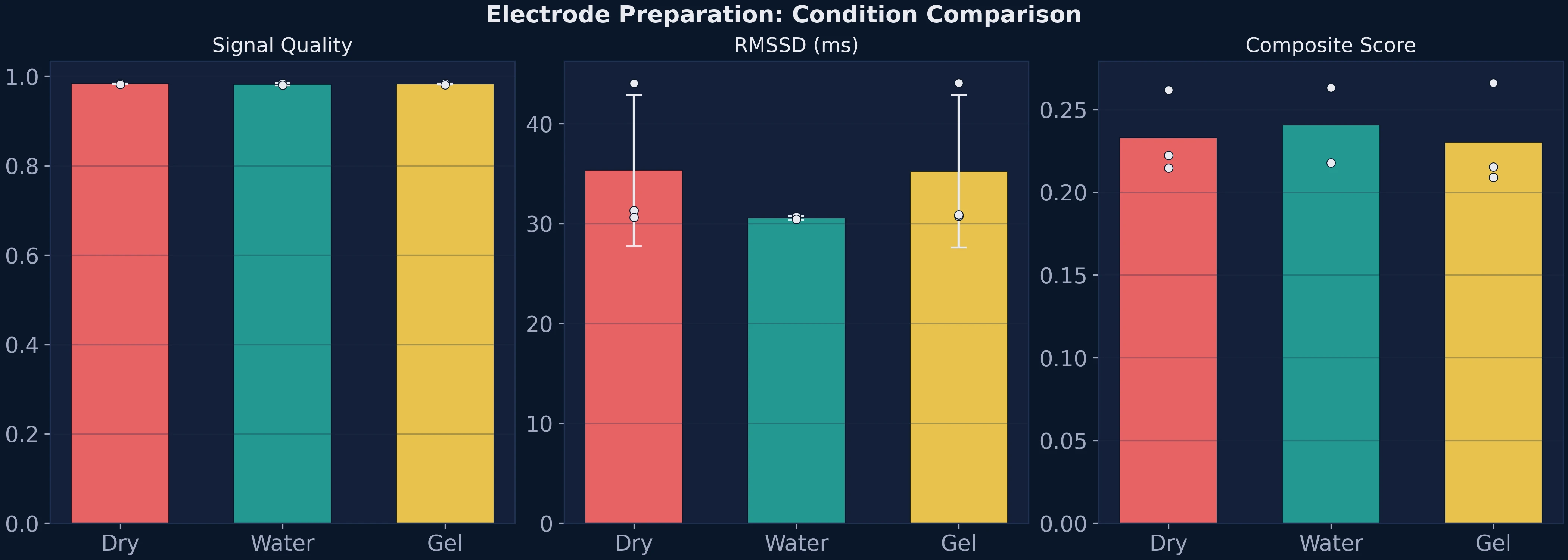
Signal quality, RMSSD, and composite HRV score by electrode condition. Individual data points (white dots) are overlaid on condition means. All three preparations are statistically indistinguishable.
The numbers tell the story:
- Dry electrodes: signal quality 0.983
- Water-moistened: signal quality 0.982
- Electrode gel: signal quality 0.983
Artifact rate was 0.0% across all conditions. There is no measurable difference between the three preparations.
What About the First Few Minutes?
A common theory is that dry electrodes start noisy but improve as sweat builds up. We checked by computing signal quality in sliding 2-minute windows throughout each session.
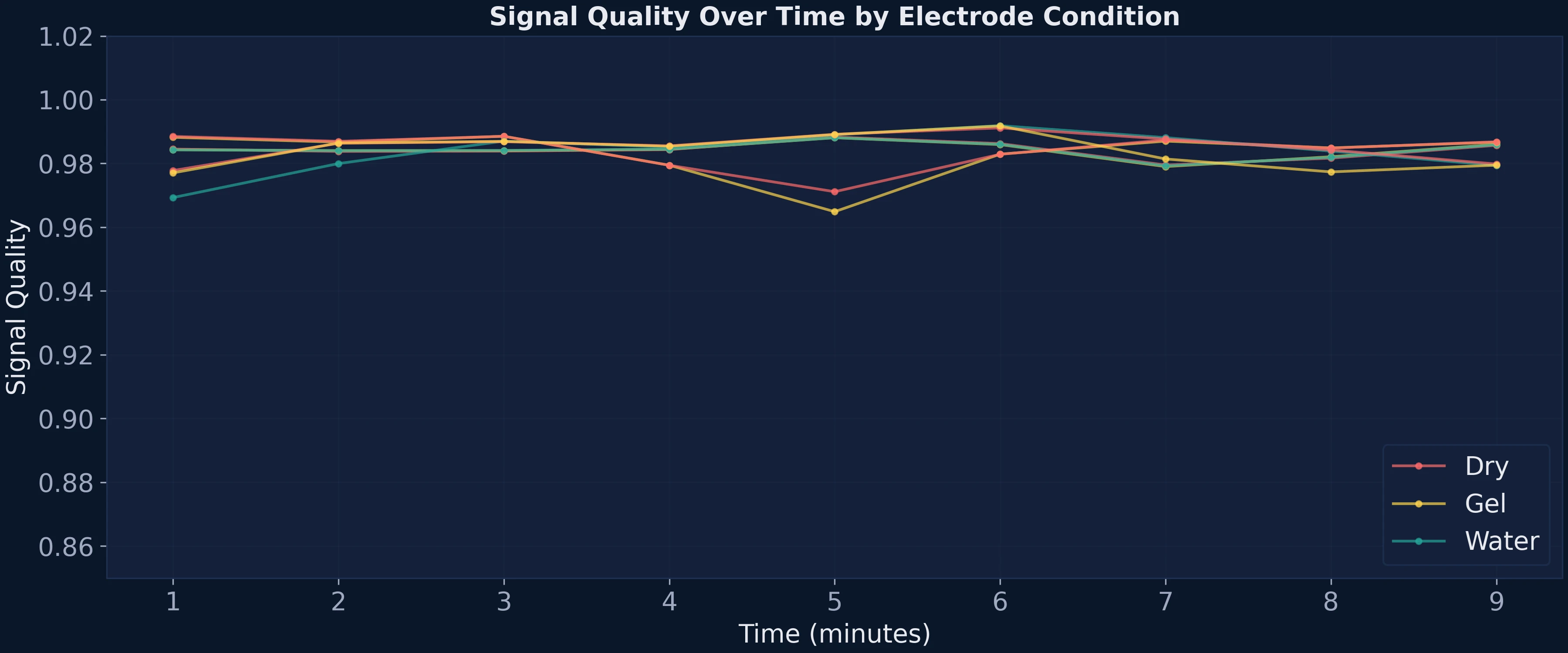
Signal quality over time by electrode condition. Even dry electrodes (coral) hit >0.97 from the first measurement window. There is no “warm-up” period.
Even with completely dry electrodes, signal quality exceeded 0.97 from the first minute. There is no warm-up ramp. In a room-temperature indoor environment, natural skin moisture appears sufficient for immediate electrode contact.
Strap Placement
We tested three vertical positions on the chest — high (above the pectoral line), center (manufacturer recommended), and low (closer to the bottom of the ribcage). Each position was tested on multiple straps across the Latin square.
Position Results
- Top position: signal quality 0.982
- Middle position: signal quality 0.983
- Bottom position: signal quality 0.983
Placement makes no meaningful difference as long as the electrode pads have good skin contact. Don't overthink it — anywhere on the lower chest works.
Budget vs. Premium: Accuracy vs. Reliability
Our device comparison testing showed that the CooSpo 808S matches the Polar H10 in RR interval accuracy. But during the electrode preparation test, we encountered a different issue.
Reliability Observation
In Session 2 of our gel test, the CooSpo 808S connected via Bluetooth but failed to transmit any heart rate data for the entire 10-minute session. The device appeared paired and active — it simply sent nothing. Sessions 1 and 3 worked normally.
We did not observe this behavior with the Polar H10 or Garmin HRM-Dual in any of our testing.
This highlights an important distinction: accuracy (how precise the data is when it arrives) and reliability (whether the data arrives at all) are different things. Budget straps can match premium straps on accuracy, but may be more prone to intermittent connection issues.
If you own a budget chest strap, it's worth trying — the accuracy can be excellent. If you're buying new and want the most dependable experience, the Polar H10 remains our top recommendation.
Quick Start
Getting started in 30 seconds
- Put the strap on. Anywhere on the lower chest, electrode pads against skin. No water, no gel, no prep needed.
- Tighten until snug. You should be able to fit one finger under the strap. It shouldn't slide when you breathe deeply.
- Open Precise Breath and connect. The app will find your chest strap automatically.
- Start your session. Signal quality will be excellent from the first breath.
Methodology
This testing used a within-subject Latin square design: 3 devices × 3 electrode conditions × 3 strap positions, with each combination appearing exactly once. All sessions were 10 minutes at 4.75 breaths per minute, seated, at room temperature (~22°C). Signal quality is computed using the same algorithm that powers Precise Breath's real-time HRV analysis — a composite of artifact-free interval ratio (70% weight) and coefficient of variation (30% weight).
Limitations: single subject (n=1), indoor conditions only, sessions run sequentially (later sessions may benefit from accumulated skin moisture). One of nine observations was lost to a CooSpo device dropout, reducing the water condition to n=2. Full data available on request.
All devices were purchased with our own money. We received no sponsorship, free products, or reimbursement from any device manufacturer.
Ready to find your resonant frequency?
Download Precise Breath and pair any chest strap to get started. No special preparation needed.