 Precise Breath
Best Chest Straps for HRV Biofeedback
We tested popular chest straps head-to-head for beat-to-beat accuracy. Here's what works for HRV biofeedback.
Why RR Interval Accuracy Matters
Most chest strap reviews test exercise heart rate accuracy — does it read 155 BPM correctly during a run? Nobody tests beat-to-beat RR interval precision during slow breathing at rest.
That's exactly what we measure — because for resonant frequency training, it's the only thing that matters. Precise Breath analyzes the timing between individual heartbeats at millisecond resolution to find your optimal breathing rate. A chest strap that reports accurate average heart rate but noisy beat-to-beat intervals will produce unreliable HRV results.
We wear each device simultaneously with a Polar H10 reference and compare every heartbeat. The results below show which straps deliver the accuracy that HRV biofeedback demands.
Device Rankings
| Device | Signal Quality | RR Correlation | Mean Error | Verdict |
|---|---|---|---|---|
| Polar H10 Reference | 0.975 | — | — | Recommended |
| Garmin HRM-Dual | 0.954 | 0.998 | 0.9 ms | Recommended |
| CooSpo 808S (budget strap) | 0.965 | 0.999 | 1.3 ms | Accurate, but reliability concerns |
Signal quality and correlation are averages across three 10-minute test sessions at different breathing rates. Mean error is the average absolute RR interval deviation from the Polar H10 reference.
How We Test
We test every device under identical conditions, worn simultaneously with a Polar H10 reference on the same person.
Three Breathing Rates
We test at 4.5, 5.5, and 6.5 breaths per minute — the full range used in resonant frequency breathing. Each rate produces a different HRV oscillation pattern, so the sensor must perform well across all of them.
10 Minutes Per Session
Each session collects 500+ heartbeat intervals per device — enough for reliable beat-to-beat comparison.
Simultaneous Wear
All devices are worn at the same time on the same person, eliminating physiological variation between tests.
Position Rotation
Chest position matters when wearing multiple straps. We rotate straps between sessions so each device takes a turn in the center (optimal), high, and low positions — ensuring no device is advantaged by placement.
Automated Analysis
Precise Breath's own signal processing pipeline computes signal quality, artifact rate, spectral amplitude, and phase coherence for each device.
Signal Quality
Signal quality is a composite score from 0 to 1 that reflects how clean a device's heartbeat data is. It combines two factors: the percentage of beats that survived artifact detection (noisy or missing readings are discarded) and the consistency of beat-to-beat timing. A score above 0.70 means the data is reliable enough for spectral HRV analysis; below that, noise corrupts the results.
Each group of bars compares the three devices at one breathing rate. The dashed line at 0.70 is the minimum for reliable HRV analysis. Higher is better.
What we found: All three devices cleared the threshold by a wide margin at every rate. The Polar H10 and CooSpo 808S scored nearly identically (0.96–0.99). The Garmin HRM-Dual dipped slightly at 6.5 BPM (0.90) but still landed well above the 0.70 cutoff. All three produce data clean enough for accurate resonant frequency estimation.
Head-to-Head Results
Spectral Fidelity
When you breathe at a steady rhythm, your heart rate oscillates in sync. HRV biofeedback works by measuring this oscillation — using frequency analysis to find the "peak" in your heart rate variability that corresponds to your breathing rate. If a chest strap introduces noise or smooths the data, this peak weakens, and the app can't accurately identify your resonant frequency.
This is the most important test: does the device preserve the breathing-driven HRV peak? We compare the frequency spectrum from each device against the Polar H10 reference. If the curves overlap, the device is faithfully capturing the signal that matters.
Each panel shows the frequency spectrum at one breathing rate. The tall peak is your breathing-driven HRV oscillation — the signal Precise Breath uses to find your resonant frequency. The dashed line marks the target rate. If a device's colored line overlaps the Polar H10 reference (yellow), it's faithfully capturing the signal. Hover for exact values.
What we found: At all three rates, the Garmin and CooSpo curves land directly on top of the Polar H10 reference. The peak heights are nearly identical: the Garmin's spectral amplitude ratios were 1.00, 1.01, and 0.95 across the three sessions, and the CooSpo's were equally close. Neither device smooths, filters, or distorts the HRV signal — the breathing peak arrives at full strength. This also puts to rest a common concern in the HRV community: the Garmin HRM-Dual does not smooth RR intervals.
Beat-to-Beat Correlation
An "RR interval" is the time between two consecutive heartbeats, measured in milliseconds. HRV biofeedback depends on tracking how these intervals change from beat to beat, so the device needs to get each one right — not just the average heart rate. A device that's accurate on average but noisy on individual beats will produce unreliable results.
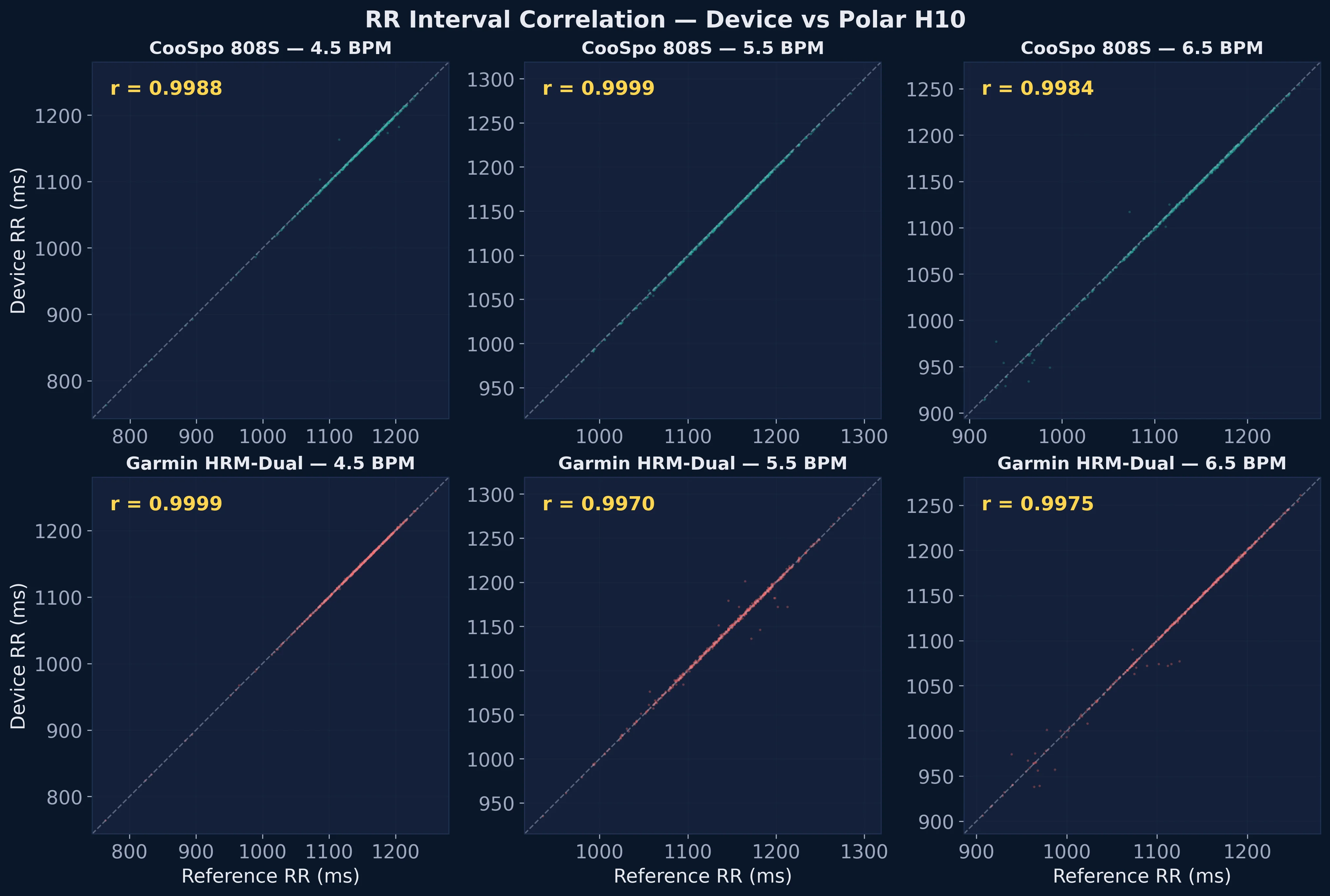
What we found: Both devices track the Polar H10 almost perfectly, with r > 0.997 in every session. The dots hug the diagonal so tightly they're hard to distinguish from it. The CooSpo 808S scored 0.999; the Garmin HRM-Dual, 0.998 — both well above the 0.95 threshold for reliable HRV analysis. In practical terms, swapping either device for the Polar H10 would give you the same heartbeat timing data.
Error Distribution
Correlation tells us whether two devices agree on the pattern of heartbeat timing, but not how large the individual differences are. Error distribution answers a different question: when the devices disagree, by how many milliseconds?
Each histogram shows how many beats fell at each error level. The horizontal axis is the error in milliseconds (difference from the Polar H10); the vertical axis is the number of beats at that error. A tall, narrow spike at zero means near-perfect agreement on almost every beat.
What we found: Nearly all beats cluster at zero error. The CooSpo 808S landed 99% of beats within ±5 ms (mean error: 1.3 ms). The Garmin HRM-Dual landed 98% within ±5 ms (mean error: 0.9 ms). For context, a typical heartbeat interval is 800–1200 ms, so these errors amount to less than 0.2% of the measurement. The occasional outlier beyond ±20 ms is caught by the app's artifact detection algorithm and doesn't affect your results.
Detailed Comparison
| Metric | Garmin HRM-Dual | CooSpo 808S | Threshold |
|---|---|---|---|
| Matched Beats | 542 | 546 | — |
| Signal Quality | 0.954 | 0.965 | ≥ 0.70 |
| Artifact Rate | 0.6% | 0.3% | < 10% |
| RR Correlation (r) | 0.9981 | 0.9990 | > 0.95 |
| MAE (ms) | 0.9 | 1.3 | — |
| RMSE (ms) | 3.2 | 2.7 | — |
| Bias (ms) | −0.2 | −1.0 | — |
| LoA Width (ms) | 12.5 | 9.5 | — |
| Within ±5ms | 98% | 99% | — |
| Within ±10ms | 98% | 99% | — |
| Verdict | Recommended | Recommended | — |
All values are averages across three test sessions. Signal Quality (0–1): data cleanliness (above 0.70 is usable; above 0.95, excellent). Artifact Rate: percentage of beats discarded as noise. RR Correlation: beat-for-beat agreement with the Polar H10 (1.0000 = perfect). MAE (Mean Absolute Error): average timing difference per beat. RMSE: same idea, but weights larger errors more heavily. Bias: whether the device consistently reads high or low. LoA Width (Limits of Agreement): the range capturing 95% of all differences — narrower is better.
What we found: Both devices exceed every threshold by a comfortable margin. The Garmin HRM-Dual has a slight edge on mean error (0.9 vs 1.3 ms); the CooSpo 808S has tighter limits of agreement (9.5 vs 12.5 ms) and a higher correlation (0.999 vs 0.998). In practice, these differences are negligible — both are well within the accuracy HRV biofeedback requires. Neither shows meaningful bias (within 1 ms of the reference on average), and both discard fewer than 1% of beats as artifacts.
Bland-Altman Agreement
The Bland-Altman plot is the standard clinical method for assessing whether two measurement devices are interchangeable. Unlike correlation (which shows whether measurements move together), Bland-Altman reveals the actual size and direction of disagreements — and whether those disagreements stay consistent across the measurement range or get worse at certain heart rates.
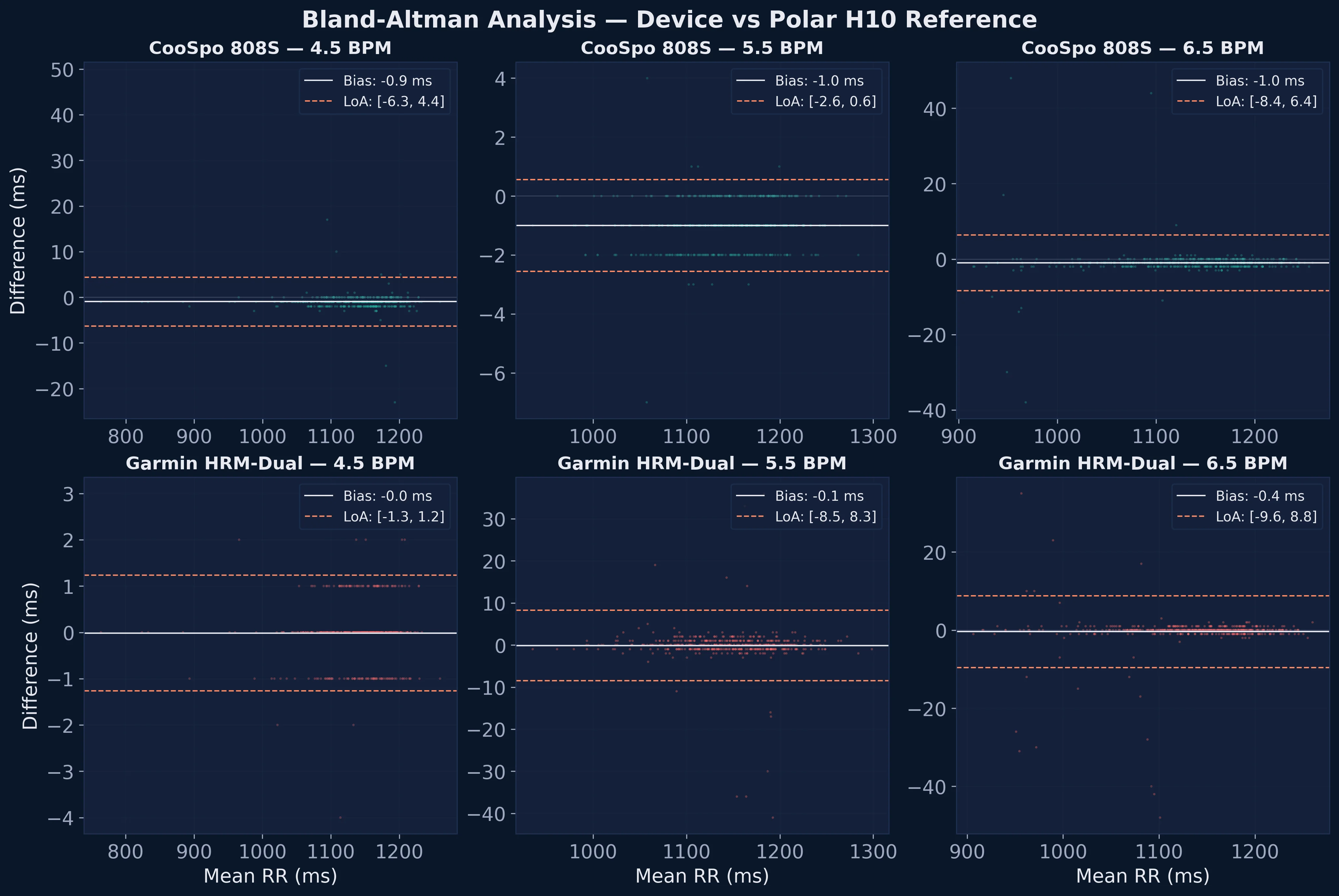
What we found: Both devices cluster tightly around zero with no drift across the measurement range. The Garmin HRM-Dual shows −0.2 ms bias (essentially zero) with limits of agreement of ±6.3 ms. The CooSpo 808S shows −1.0 ms bias with even tighter limits of ±4.8 ms. Neither reads consistently high or low, and errors don't worsen at any particular heart rate. By clinical standards, both are interchangeable with the Polar H10.
RR Interval Traces
This is the most intuitive view of the data: the raw heartbeat-to-heartbeat timing from all three devices, overlaid on the same timeline. While the statistical tests above prove the devices agree, this chart lets you see it.
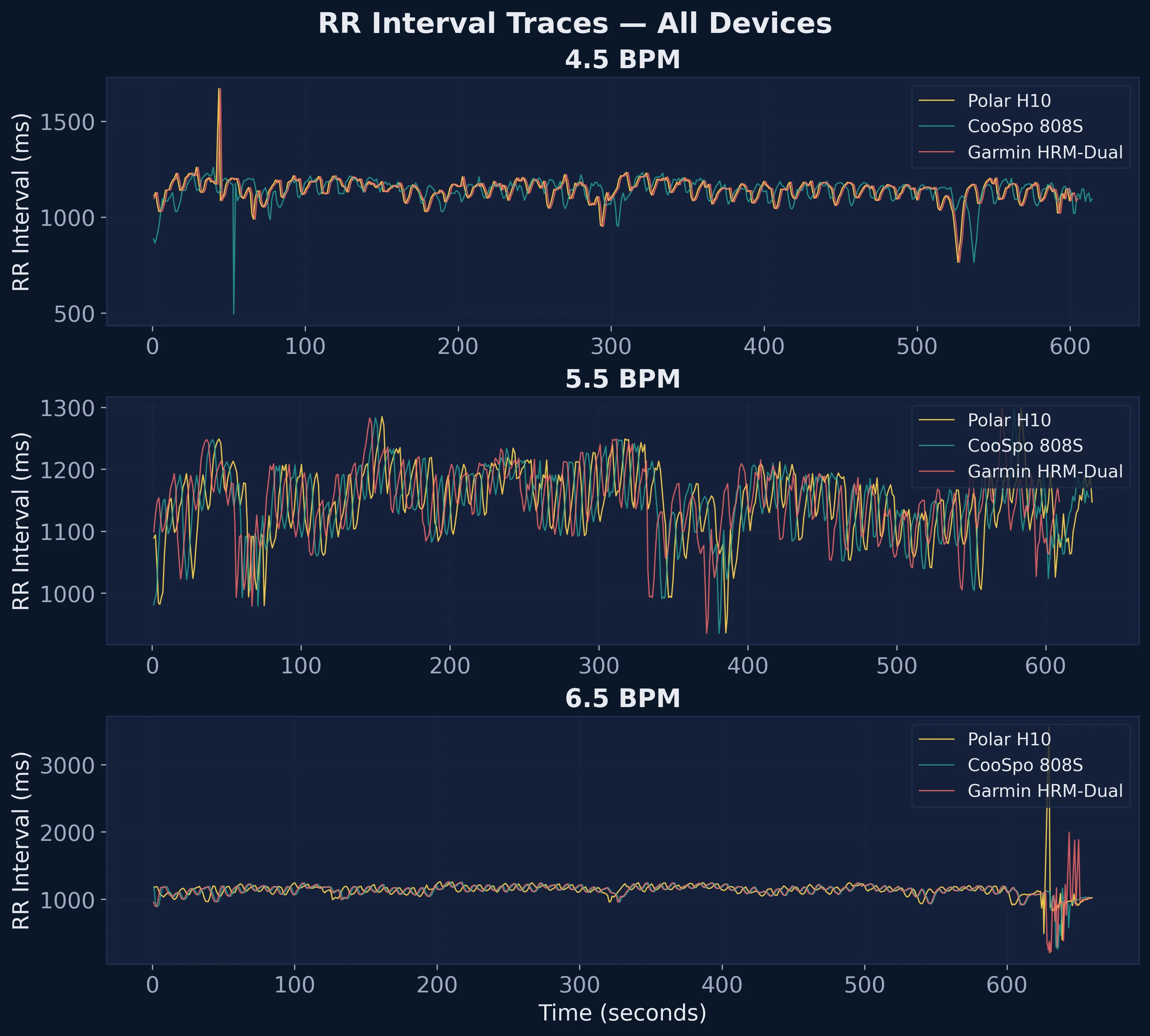
What we found: The three traces overlap so completely they appear as a single line — you cannot tell which device produced which measurement. This holds at all three rates, from the large oscillations at 4.5 BPM (top) to the smaller ones at 6.5 BPM (bottom). Slower breathing produces bigger HRV swings, which is expected and one reason we test at multiple rates.
The Bottom Line
All three devices delivered RR interval accuracy equivalent to the research-validated Polar H10 — with one reliability caveat.
The Polar H10 remains our top recommendation: consistently accurate and reliable. The Garmin HRM-Dual matched it in every metric and is an equally strong choice. We included the CooSpo 808S to answer a common question: do budget straps actually work for HRV? When it works, its sub-2ms accuracy matches the Polar H10. But in practical testing we observed one instance where the CooSpo connected yet failed to send any heart rate data for a full session — a reliability concern we have not seen with the Polar or Garmin.
Precise Breath does not support optical wrist sensors or smartwatches. While PPG sensors report heart rate accurately enough for fitness tracking, they lack the beat-to-beat timing precision required for spectral HRV analysis. This is a hardware limitation, not a software choice.
Do I need to wet my chest strap?
We tested dry, water, and electrode gel preparations across three chest straps in a controlled comparison. All three produced identical signal quality (>0.98) with 0% artifact rate — even from the first minute. Strap position didn't matter either.
Frequently Asked Questions
Which chest strap should I buy?
We recommend the Polar H10 for the best combination of accuracy and reliability. The Garmin HRM-Dual is equally reliable and matched the Polar in every metric.
The CooSpo 808S delivered excellent accuracy when working — within 2ms of the Polar H10 — but we observed a reliability issue (one session where it connected but failed to transmit data) even in limited testing. If budget is a concern, it's worth trying, but expect occasional connection issues.
Other ECG-based chest straps that broadcast standard BLE Heart Rate Service (0x180D) should work in principle, but we can only vouch for the models we've tested.
Will my existing chest strap work?
Polar H10 or Garmin HRM-Dual — yes. We've validated both and recommend them. CooSpo 808S — accuracy is excellent when working, but we observed intermittent reliability issues even in our short testing period.
Other BLE chest straps should work if they support HR Service 0x180D with RR interval data, but we haven't verified their RR accuracy for HRV biofeedback.
What about wrist sensors or smartwatches?
Precise Breath does not support wrist-based optical (PPG) sensors. PPG reports heart rate accurately enough for fitness tracking but lacks the millisecond-level beat-to-beat timing precision that spectral HRV analysis requires.
This is a hardware limitation, not a software choice — the optical measurement method cannot achieve the timing resolution that chest strap ECG electrodes provide.
Does the Garmin HRM-Dual smooth or filter RR intervals?
A common concern in the HRV community. Some users have speculated that Garmin applies smoothing or filtering to RR interval data, which would suppress the natural variability that HRV biofeedback depends on.
Our data says no. Across three breathing rates, the Garmin's spectral amplitude ratio versus the Polar H10 was 1.001, 1.008, and 0.95 — the HRV breathing peak is preserved at essentially full strength. If the firmware were smoothing, the spectral peak would be visibly attenuated. Beat-to-beat correlation above r = 0.997 and mean absolute error under 1 ms further confirm that the Garmin reports raw (or minimally processed) RR intervals, not smoothed averages.
Why did you test a budget chest strap?
To answer a question we hear often: do inexpensive off-brand straps work for HRV biofeedback, or do you need a name-brand strap?
The accuracy surprised us — the CooSpo matched the Polar H10 with 0.999 correlation and sub-2ms mean error. But in our practical testing, we observed one instance where it connected yet failed to transmit any data for a full session. The data is excellent when it arrives, but budget straps may be less reliable overall.
How do you test?
All devices are worn simultaneously on the same person, with a Polar H10 as the reference. We run three 10-minute breathing sessions at 4.5, 5.5, and 6.5 breaths per minute — covering the full range used in resonant frequency training. Straps are rotated between sessions so each device takes a turn in the center, high, and low chest positions.
Each session collects 500+ heartbeat intervals per device. We align the beat sequences and compute Pearson correlation, mean absolute error, signal quality, spectral amplitude ratio, and Bland-Altman agreement. The analysis pipeline uses the same algorithms that power Precise Breath's real-time HRV processing.
All devices were purchased with our own money. We received no sponsorship, free products, or reimbursement from any device manufacturer.
Ready to find your resonant frequency?
Download Precise Breath and pair any of the tested chest straps to get started.